
AI Data Centre Growth Faces Power Grid Challenges
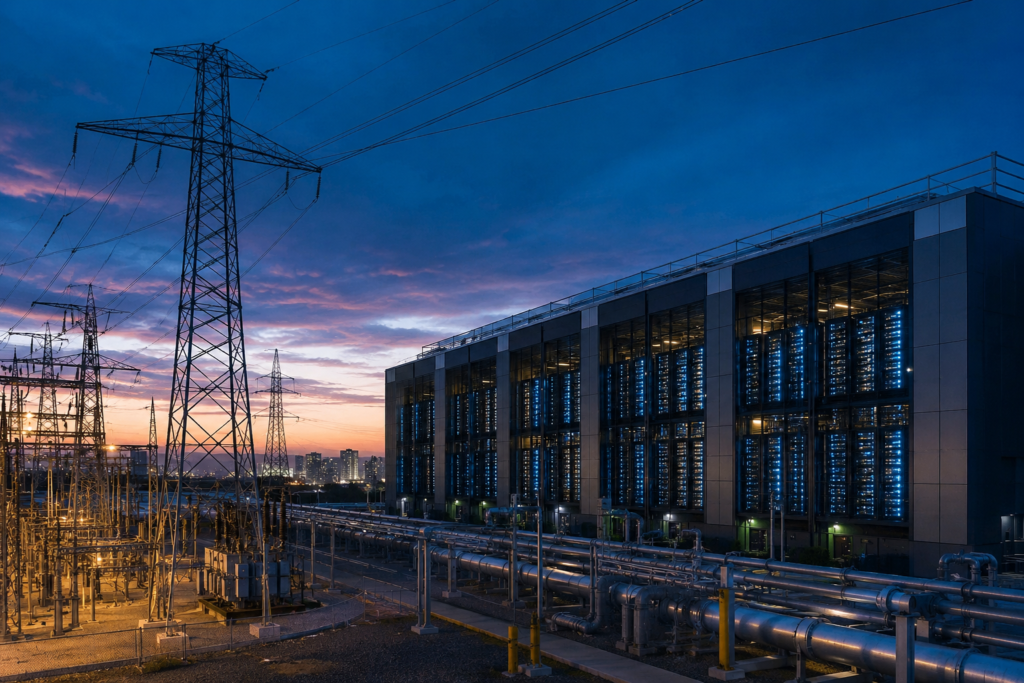
The rapid expansion of artificial intelligence is creating unprecedented demand for cloud infrastructure, but a growing shortage of electrical grid capacity is emerging as a major obstacle to the development of new AI data centres.
As organizations continue investing in generative AI, machine learning, and large language models, hyperscale data centres are consuming significantly more electricity than traditional cloud facilities. The increasing power requirements are placing pressure on existing energy infrastructure, causing delays to new data centre projects in several regions around the world.
Modern AI workloads require thousands of high-performance graphics processing units (GPUs) operating simultaneously to train and run advanced models. These systems consume substantially more power than conventional enterprise applications, making reliable electricity supply a critical factor in future AI deployment.
Cloud providers are responding by expanding their data centre footprints to meet growing customer demand. However, in many locations, power grid limitations and lengthy utility approval processes are slowing construction timelines. Even where land and investment are available, insufficient electrical capacity can delay projects for months or even years.
The challenge extends beyond cloud providers. Enterprises adopting AI-powered services also depend on scalable and resilient cloud infrastructure to support data processing, analytics, automation, and digital transformation initiatives. As AI adoption accelerates across industries, the demand for computing resources continues to grow at an unprecedented pace.
To address these challenges, technology companies are exploring new approaches to energy management. Investments in renewable energy, battery storage, advanced cooling technologies, and more energy-efficient data centre designs are becoming increasingly important. Many organizations are also working closely with utility providers and governments to strengthen grid capacity and accelerate infrastructure upgrades.
Industry experts believe the future of AI will depend not only on advances in algorithms and computing hardware but also on the ability to deliver sufficient energy to power next-generation data centres. Reliable electricity, sustainable energy sources, and modern grid infrastructure are becoming essential components of the global AI ecosystem.
The issue is also driving innovation in data centre design. Operators are deploying liquid cooling systems, energy-efficient processors, and intelligent workload management to reduce power consumption while maintaining high performance. These technologies help improve operational efficiency and support long-term sustainability goals.
As cloud computing and artificial intelligence continue to evolve together, infrastructure planning is becoming just as important as software innovation. Governments, utility companies, and technology providers will need to collaborate to ensure that power networks can support the next generation of digital services.
The growing demand for AI demonstrates that the future of cloud computing extends beyond servers and software. It also depends on resilient energy infrastructure capable of supporting the technologies that will drive the next era of digital transformation.