
China Expands Blockchain Capabilities to Strengthen Digital Infrastructure
China Expands Blockchain Capabilities to Strengthen Digital Infrastructure
China is continuing to invest heavily in blockchain technology as part of its broader push to strengthen the country’s digital infrastructure. Officials say recent developments in domestic blockchain systems are helping support sectors ranging from government services to international trade.
Speaking ahead of the opening meeting of the fourth session of the National People's Congress in Beijing, Dong Jin highlighted the country’s progress in building blockchain technologies designed and developed within China.
According to Dong, blockchain has become one of the key technological foundations supporting the growth of the digital economy.
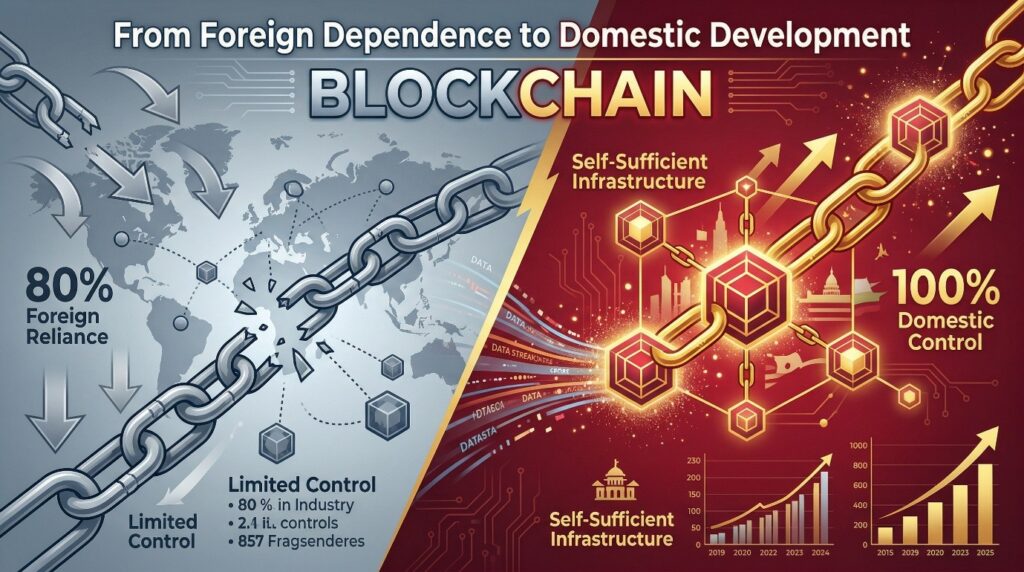
From Foreign Dependence to Domestic Development
Blockchain technology first gained traction in China several years ago, with early applications appearing in areas such as energy management, trade systems, and government services.
However, many of those initial systems relied on foreign-developed technologies.
In 2019, the Beijing Academy of Blockchain and Edge Computing was established with support from the Beijing municipal government to address that gap. The institute brought together researchers and scientists from around the world to develop foundational blockchain technologies locally.
The goal was to create a fully domestic system capable of supporting large-scale national infrastructure.
Building a “Chinese Core” for Blockchain
Researchers at the institute eventually developed a software-and-hardware integrated blockchain operating system designed to improve the efficiency and scalability of blockchain networks.
The platform includes roughly three million lines of open-source code, allowing developers and organizations to access and build upon the system. According to Dong, the project aims to expand the social and economic value of blockchain technology by making its underlying structure widely accessible.
Alongside the operating system, the team also introduced a specialized 96-core acceleration chip designed specifically for blockchain workloads. Officials say the chip significantly improves performance, potentially increasing blockchain processing capacity by up to fifty times.
Such improvements are intended to address one of the major technical challenges facing large blockchain networks: managing high volumes of transactions while maintaining security and reliability.
Expanding Use Across Government and Industry
Blockchain applications in China have grown steadily in recent years. According to Dong, systems developed by the institute are currently used by 16 central government departments and 27 state-owned enterprises.
One prominent example is the country’s electronic invoicing system. Tens of billions of invoices issued annually are processed through blockchain-based systems that help verify authenticity and ensure transaction records cannot be altered.
By maintaining transparent and traceable records, blockchain systems are intended to reduce fraud and improve administrative efficiency.
Beyond taxation, blockchain networks are also being used to support cross-border trade documentation and financial transaction tracking.

A Foundation for the Digital Economy
Experts often describe blockchain as one of several key technologies supporting modern digital infrastructure. In addition to algorithms and computing power, trusted and verifiable data has become increasingly important for emerging technologies such as artificial intelligence.
Blockchain systems can help ensure that stored data remains authentic, traceable, and resistant to tampering — qualities that are valuable in financial services, logistics, digital identity systems, and government administration.
Officials say China’s growing blockchain network now plays a role in securing high-value data used in international trade and global payments.
Looking Ahead
As digital economies expand worldwide, many countries are exploring blockchain as part of their technology strategies. While cryptocurrencies are often the most publicly visible use of blockchain, governments and businesses are increasingly focusing on its potential for record keeping, verification systems, and secure data sharing.
China’s recent developments suggest a continued emphasis on building domestic capabilities in foundational technologies.
For the public, the effects may appear gradually — through digital government services, financial systems, and more efficient verification processes in everyday transactions.
While much of the underlying infrastructure remains largely invisible to consumers, blockchain is steadily becoming part of the systems that support modern digital economies.